
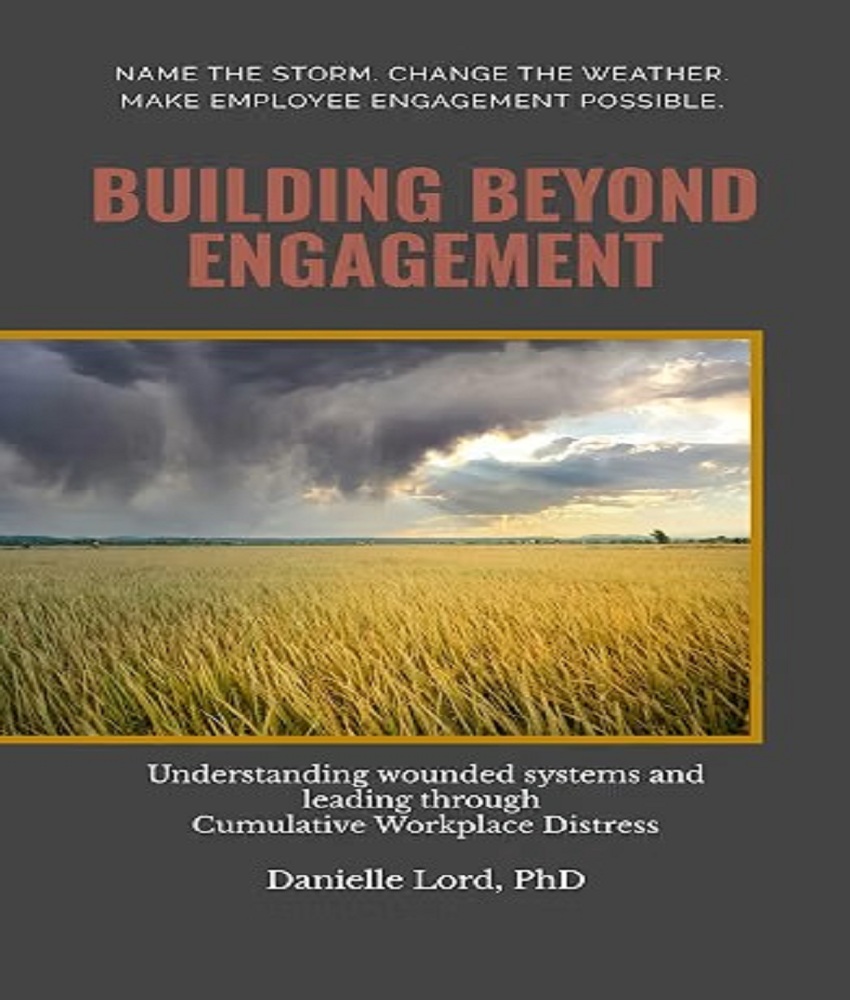

Author, Danielle Lord, PhD releases Building Beyond Engagement, a New Guide for Leaders Navigating Employee Disengagement through Cumulative Workplace Distress
New book challenges leaders to look beneath employee-engagement scores and address the workplace conditions that make people withdraw, burn out, or leave.
Danielle Lord, PhD, announces the release of Building Beyond Engagement: Understanding Wounded Systems and Leading Through Cumulative Workplace Distress, a new nonfiction leadership book that challenges conventional approaches to employee engagement.
Rather than treating low engagement as a motivation problem, or attempting to solve it with perks, surveys, recognition programs, or superficial culture initiatives, Lord asks leaders to look underneath the numbers. The book explores how chronic role stress, emotional masking, moral tension, organizational history, and psychologically unhealthy work conditions can gradually erode employees’ wellbeing, trust, sense of identity, and willingness to contribute.
At the center of the book is Lord’s developing framework of Cumulative Workplace Distress (CWD): the slow, repeated erosion of wellbeing and identity that can occur when people spend too long working inside conditions that feel unclear, unsafe, unsupported, or morally injurious. CWD offers leaders language for patterns often discussed separately, including burnout, compassion fatigue, moral injury, emotional exhaustion, workplace trauma, and disengagement.
“Employee engagement is not something leaders can demand from people who are already protecting themselves,” Lord said. “It becomes possible when leaders are willing to name the storm people are standing in, and change the conditions that have made work too confusing, too punishing, or too costly to inhabit with a whole self.”
Drawing on more than two decades of research and real-world leadership experience in healthcare, long-term care, manufacturing, and other high-pressure settings, Building Beyond Engagement traces how the historical design of work has shaped many modern organizational challenges. Lord connects present-day concerns, including staffing pressures, role overload, return-to-office conflict, artificial intelligence, economic insecurity, and declining trust to longstanding systems that have often rewarded endurance over honesty and productivity over people.
The book offers a different leadership question. Instead of asking, “How do we get people more engaged?” Lord encourages organizations to ask: “What kind of workplace are we teaching people to survive?”
Building Beyond Engagement takes the next step: if engagement is more than numbers, what does it actually look like to build organizations that recognize and repair distress while still pursuing performance and excellence?
This book explores how workplace culture, leadership behavior, governance structures, and unspoken norms create conditions that either amplify or mitigate cumulative distress. It examines topics such as:
- The difference between burnout, moral injury, and cumulative workplace distress
- How repeated exposures to micro‑traumas at work shape behavior, trust, and performance over time
- Why traditional performance management and “engagement campaigns” often deepen harm rather than resolve it
Readers are guided through practical models for redesigning leadership practices, team routines, and organizational responses to distress. The book emphasizes trauma‑informed leadership, systemic thinking, and the necessity of naming harm without collapsing into blame. Case examples and stories help leaders recognize patterns in their own settings, while reflection prompts invite them to examine their role in both sustaining and shifting those patterns. Building Beyond Engagement is for leaders and change agents who are ready to move from awareness to structural and behavioral change.
Who this book is for
Building Beyond Engagement is written for people who sit at the intersection of leadership, care, and responsibility, including:
- Healthcare leaders, physician executives, nurse managers, and allied-health professionals
- Nonprofit directors, HR leaders, organizational-development professionals, and learning leaders
- Managers, supervisors, and team leaders responsible for employees’ daily work experience and wellbeing
- Executives seeking to understand the human patterns beneath turnover, burnout, conflict, disengagement, and workforce instability
- Change agents ready to move from awareness to practical structural and behavioral change
The book recognizes the realities of constrained resources, regulatory pressures, competing demands, and organizational politics. At the same time, it refuses to treat distress as a private employee problem to be fixed in isolation. It offers leaders language, tools, and hope without minimizing the real cost of change
Core Themes
Across all three books, several themes repeat and deepen:
- Cumulative Workplace Distress: How repeated experiences at work accumulate and shape people’s bodies, minds, relationships, and decision‑making—and why acknowledging this is a precondition for genuine engagement.
- Trauma‑Informed Organizational Practice: How principles like safety, trustworthiness, choice, collaboration, and empowerment apply not only to direct care, but to how organizations are led and structured.
- Systemic Leadership: Moving from “fixing individuals” to understanding and redesigning the systems, patterns, and archetypes that hold current realities in place.
- Engagement as Relationship, Not Metric: Treating engagement as a dynamic, relational phenomenon between people and their work settings, rather than a number to chase or manipulate.
- Practical, Field‑Ready Tools: Ensuring that every insight is matched with a way to act—whether through a conversation, a team exercise, or a design decision.
“Leaders cannot promise people an easy workplace,” Lord said. “But they can make work more honest, more sustainable, and more humane. They can create clearer expectations, interrupt harmful patterns, repair what has been damaged, and make it easier for people to stay, care, and contribute.”
Building Beyond Engagement: Understanding Wounded Systems and Leading Through Cumulative Workplace Distress is now available in paperback and Kindle editions.
About Danielle Lord
Danielle Lord, PhD | Leadership Development researcher & Solutions architect

Danielle Lord, PhD is a leadership development researcher and creator of evidence-based tools that help leaders repair, reimagine, and rebuild healthier organizations. Drawing on three decades of work at the intersection of organizational development, well-being, and learning design, she translates complex data and real-world experience into practical playbooks, curricula, business solutions, and books for clients across sectors.
Her books include: Focused Moments, Engaging Your Employees, and Building Beyond Engagement.
Her portfolio includes leading leadership development and learning strategy for the Port of Seattle, serving as Chief Learning Officer for the State of Washington, and directing physician and leader development for Providence Health & Services, a five-state health system with 75,000 employees. As founder of her own practice and projects like HelixMD, she designs “leadership labs” and recovery-focused development experiences for physicians and other leaders navigating high-stakes, high-burnout environments.
Since 2008, Danielle has served as graduate faculty at Brandman University, teaching more than 17 different leadership and organizational change courses and developing over 48 custom programs and courses for organizations of all sizes. She earned her PhD in Leadership Theory in 2007, where she studied nursing dissatisfaction, and continues to conduct qualitative research into the developmental and recovery needs of aspiring physician leaders.
A Pacific Northwest native, Danielle lives in Auburn, Washington with her husband, Stephen, their cat “Kitten,” and they have five adult children. When she is not designing new tools or gathering stories from the field, she can be found antiquing, gardening, or enjoying a good glass of wine.


Leave a comment