“In this beautifully crafted page-turnerset in an imaginary world just beneath our feet,Don Sawyer has given us a deeply entertaining story of magic, ancient evil and the ability of love, courage and hope to overcome it. He reminds us of the power of imagination and fantasy to probe deeper questions of justice, sustainability, and belonging.” — Frye Gaillard, author of The Cradle of Freedom, winner of the Lillian Smith Book Award, A Hard Rain, named an NPR Great Read of 2018; and The Southernization of America, an NPR Best Book of 2022
“The Tunnels of Buda — the second instalment in Don Sawyer’s Soul Catcher series — is a fabulous sequel to The Burning Gem. The novel’s propulsive plot and mysterious settings — including a maze of shifting catacombs beneath the ancient palace of Budavári Palota — along with its wide cast of nuanced characters, make for an exhilarating rideas Zoltan and Barbara team up to attempt the overthrow once and for all of the tyrannical cabal known as The Company. The Tunnels of Buda makes this epic showdown — one very relevant to our own market-driven society — the centre of its compelling narrative.”— Mark Morton, author of The Headmasters
“Memorable, action-packed, and gripping in its delivery… the twists and turns this narrative faces, and the richly developed cast of characters, gave this novel the push needed to cement the universe the author crafted into place and bring readers in.” — Anthony Avina, author of the Nightmare Academy Series
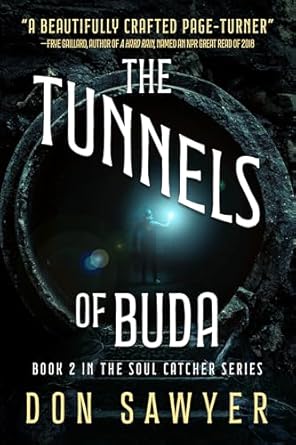
Don Sawyer’s THE TUNNELS OF BUDA, the second romantic fantasy thriller in the Soul Catcher series, in which a magical gem maker and an empath struggle against a hideous conspiracy of evil headquartered in a maze of fantastic tunnels deep below Hungary’s Buda Castle.
The Mester is dead or maimed and the black stone used to control his network of gem makers is in Barbara and Zoltan’s hands. But as Zoltan discovered in the ruin bars of Budapest from a former associate, who turned up beheaded and his hands cut off, the Mester was just a small part of a much larger cabal, an ancient Order dating back to Aristotle and beyond. The Order has one goal: to convince the populace that there are masters divinely intended to rule and slaves meant only to obey. Using magic and sorcery, both ancient and modern, they will stop at nothing to protect the rule of the aristoi. But this time the “slaves” are fighting back, drawing on the knowledge and skills from many traditions and backgrounds, including magic of their own, to battle this shadowy cabal and its message of fear, division and hopelessness. In The Tunnels of Buda Zoltan, the 110-year-old gem maker and Barbara, empath and gem wielder, veer in new and terrifying directions, facing evil on an unimagined scale. They are drawn to the lair of the Justin, so powerful he controls the minds of all around him and who commands the Company, a hidden underground futuristic complex that serves as the hub of the Order’s monstrous conspiracy to enact the darkest of Nietzsche’s Weltanschauung. Barbara and Zoltan find new allies and diabolical enemies as they fight for their lives in the mines and ancient tunnels deep below Buda Castle in Budapest.
Ready to learn more about The Tunnels of Buda and the author behind it? Keep reading for our interview with Don Sawyer!
Author Don Sawyer, greetings, and thank you so much for taking the time to answer our questions about your new release, The Tunnels of Buda, book two in the Soul Catcher series.
Author Sawyer: First of all, thanks for inviting me and especially for the outstanding review of The Tunnels of Buda. I was pleased not only with the kind comments about the book itself but also with the thinking behind the book.
When you start off Tunnels of Buda you weave in a quick but engaging recap of what transpired in book one. That was a specific aspect of the book that we truly appreciated and one that we’re sure other readers will appreciate as well. Why did you choose to do this?
Author Sawyer: Interesting question. I wrote the two books together as a single, really long novel – the original version ran almost 200,000 words. After doing everything I could, including working with a very talented editor, I realized I just could not get the book down to size that would interest publishers.
So I decided to rewrite it as two separate novels. As you can imagine, when doing this, you can’t just end in the middle and then make the next section chapter one of the second book. I had to make sure that both books could be read as separate self-standing reads, even though they were intended to be read together.
This required a considerable review of The Tunnels of Buda of at least the basics from The Burning Gem in order to bring new readers up to speed. Although I used the memo to the other gem makers as the main mechanism for this review, I included various inclusions, such as Barbara’s reflection on the Market, over the first few chapters to help give readers a sense of place, conflict, and the main characters involved.
Wow! The original version ran almost 200,000 words?! That would have made for an amazingly huge book! It definitely would have made for quite the daunting read, so we’re sure that readers are more than pleased that it was broken up into a series instead of one huge book! LOL!
As we delve into Tunnels of Buda, we get the sense that compared to book one, it appears that you’ve really hit your stride with this book. What was it that really drove you while you wrote this novel?
Well, thank you. I tend to agree. With the first book, I was intent on world-building and character development as well as hinting at the scope of the evil behind the gem-making operation. With The Tunnels of Buda, I could concentrate more on the confrontation between forces and explore the chilling power and nature of the cabal’s real purpose. It provided a canvas for more adventure, desperation, magic, and revelation of who and what Barbara and Zoltan are dealing with.
Each of the characters in this book has beautiful and unique gems. These gems are more than just pieces of their souls, they hold magic as well. How did you come up with this particular element of the story?
Author Sawyer: Although sharing far more than what separates us, each human is unique in character and potential. Whether you take it literally or figuratively, that is how I’m using the term “soul.” So it stands to reason that since the stone accelerates those innate qualities, these would also be reflected in the magic imparted by their stones.
In Barbara’s case, for instance, I spend a good deal of time analyzing her largely unconscious relationship to fire. Whether from her somewhat sheepish acknowledgment that she is an Aries, a fire sign, to Zoltan’s further exploration of her name, her power is fire, and she manifests and hones this as she learns the power of her gem.
“Since you have approved my name, I will approve the correct pronunciation of yours. I will use the German version: BAHR-bah-rah. It seems to fit you. It is a bit edgy, as they say, yes? Barbed, perhaps?”
Barbara laughed. “Perhaps. You wouldn’t be the first person to say so.”
“I am not surprised,” the man smiled. “And it is a name that fits in other ways, no?”
“Such as?”
“In Greek, it means ‘foreign woman.’” He paused thoughtfully. “A woman who travels from a distant land.”
“Really?”
“Quite so. You know the story, yes? Of Saint Barbara?”
“Sort of. Wasn’t she killed by her father?”
“Indeed she was. With his sword because she would not do as he ordered. But afterwards he was struck by lightning and died a terrible death. So, she became the patron saint of artillerymen, gunsmiths. Anyone who worked with fire and explosives.”
She leaned back in the high, leather chair, looking at the man curiously. “Go on.”
“Ah. This is not enough? So. You have heard of the Cuban religion of Santería?”
Barbara shook her head.
“It is an ancient religion from Africa that came over with the slaves. Like all religions, they mixed their old beliefs with new ones. In Santería Barbara became Chango, the deity of fire, lightning, and thunder.”
In this book, Tunnels of Buda, you introduce and bring readers face to face with the man behind the machine so to speak. The true master mind. This character is quite dark, devious, and truly dangerous. How did you come up with this character?
Author Sawyer: Can I use that line – “This character is quite dark, devious, and truly dangerous.” From the beginning, I knew the Mester was simply a servant to something much larger, much darker, a cabal with ancient roots and unlimited resources. A conspiracy of which the gem scheme was only a small part, a shadowy league which used both ancient and modern magic to sow discord and the myth of the divine right of wealth and power.
To be the embodiment of such evil, the wielder of such power, and to detest humanity as a whole with a passion that erases all empathy and replaces it only with a total dedication to power requires a figure of “superhuman” — as Nietzsche might have seen him — or from my view “inhuman” proportions. Justin is a combination of the two.
Wow. We just got chills. LOL!
We didn’t even notice this when we read book one in the Soul Catcher series, but there are no female agents, gem makers! We probably wouldn’t have noticed at all if Justin hadn’t made a point of stating this. Why aren’t there any female agents?
Has it always been that there have been no female agents?
Author Sawyer: Yes. As Zoltan explains the selection of agents to Barbara,
“You see, I think he can sense heartbreak. Depression and sadness. He told me he only hired orphans—no families, fewer complications. And if possible, widowers. He didn’t trust women, he said. Too independent.”
In the Tunnels of Buda, we find out he has brought on women for the larger Company operation, but generally without much success. Here we are introduced to Sibyl, who dared confront him and paid the price:
Buda Castle takes on a role in this book. Was this particular castle a piece of key inspiration for your book Tunnels of Buda? If so, why?
Author Sawyer: Absolutely. Some years ago, my wife and I spent some time in Budapest. The city affected me deeply. I guess it’s not always rainy, gloomy, and depressing, but it was when we were there. And as I learned the terrible history of antisemitic pogroms, the Red Terror and White Terror massacres, the 150-year occupation by the Ottomans, the 13th c conquest by the Mongols that reportedly killed 25% of the population, the brutal occupation of Hungary by the Nazis (Hungary was an Axis power) and on and on, the city’s decaying buildings and tortured past created the perfect setting for the centre of the evil cabal (identified in the 3rd book as the ancient Order of the Golden Souls) with it’s impregnable bunker located deep below Buda Castle and its impenetrable maze of tunnels.
Wow! Buda Castle has quite the history and reputation apparently! One thing is for sure – Buda Castle is steeped in dark history that absolutely made it the perfect back drop for your book!
Have you ever visited the castle yourself?
Author Sawyer: My wife and I walked as far as we could in the tunnels accessible to the public – dark, dripping, eerie – and learned that there were miles more that had hardly been explored. So when I imagined where this evil bunch would locate, I knew the bastards were down in that labyrinth of tunnels somewhere.
You describe a labyrinth under the castle saying that it is “hundreds of miles of caves, dungeons, passageways, and cellars.” Is that part of the story based on truth or is this you taking creative license to weave a more engaging story to draw readers in?
Author Sawyer: Well, as a travel brochure puts it, “The staging of the modern day Buda Castle turns into a mixture of historical layers of medieval musty, chilly underground maze (with skulls and bones) as well as Cold War remnants: the Buda Castle Caves are a place of historical mystery and intrigue.”
Including the part that is open to the public and the much larger portion that isn’t, the known length of caves is over 10 km riddled with rooms and chambers. That’s a pretty good-sized cave. Sure, I expanded on the basic facts, but this is a setting where evil has stalked for many years. It is haunted by the ghosts of Neanderthals, tortured Nazi opponents and starving Ottoman prisoners.
So the description of the actual tunnels themselves is a mixture of fact and fiction. We’re sure that our fellow readers can ge behind that! Regardless it makes for a truly fascinatingstory that is sure to appeal to the adventurous side in all of us!
Barbara has truly grown from the woman simply looking for change in book one. With her own gem she is quickly growing and becoming something more. What was it like developing her character?
Author Sawyer: I’m glad you appreciate her development. There is always a danger when writing from the POV of another gender or culture, but in this case I felt Barbara’s desperation–perhaps from my own suffocating childhood in a soulless suburb–and from the outset knew how much more she was capable of.
I changed her early character considerably over various iterations of the book from presenting her as more of an innocent ingénue to a woman who sensed her abilities and was intensely in touch with her unhappiness but lacked the spark to act. The latter worked much better as we see the heart and sinew in the woman at the outset, so their development makes more sense.
It was fun to occupy a character who felt all the fears and doubts we all do but had the courage and determination to press on, no matter the danger. And who grew personally, emotionally and in agency as she overcame the internal and external obstacles to becoming the woman she wants to be.
You have quite the array of characters here in Tunnels of Buda. Each with their own unique personality and characteristics. Who was your favorite character to write and develop? If you don’t mind explaining – why?
Author Sawyer: I hope it’s not too heavy-handed, but in this second book, the characters not only have different skills and abilities, but are also from a range of cultural and ethnic backgrounds. One of my themes is the importance of overcoming the tribal differences that are often exploited to keep us from valuing what we have in common.
Sharing and collecting our traditional knowledge and skills are more critical than ever as we face existential challenges. I enjoyed the mid-Western brashness of Friesen, a kind of impulsive, abrasive character with a great heart. Sibyl too was fun – a blind Ghanaian (I worked in Ghana for 10 years) genius and telekinetic who dared oppose Justin and was blinded and made to appear hideous for doing so. So much of the escape depends on her, and it was interesting to plumb the depths of her character. I also have to mention Malik, my compassionate yet commanding Sikh warrior, who continues to develop in the 3rd book.
What is the number one element of Tunnels of Buda that you are excited for readers to discover as they dive into this book?
Author Sawyer: The revelation of the full extent of the evil cabal and the details of the enormous bunker – a world opposite to the free association and ideals of the utopian Market – where they are located. Although hinted at in the first book, I want readers to more fully experience the insidious myth Justin and his forces are insinuating into society: there are natural masters and slaves.
Don’t even try to fight back. We possess unimaginable power and wealth by virtue of some inborn quality. Accept your position as slaves and our dominance as masters. Barbara, Zoltan and company beg to disagree.
We have to ask the question that we’re sure that other readers are going to be wondering as this book unfolds – What is Justin? Is he human? Is he something more? There are just certain characteristics you draw to readers attention that just begs the question as to what exactly is he?
Author Sawyer: What is he indeed? In the mental discussion with Barbara before he freaks out, we learn that Justin is indeed human – a small boy abandoned in a hospital. What happened there? Mere trauma from his abandonment? Was he adopted by a team to train him for his position as leader of the caba? Did this involve inserting some magical element that makes him superhuman?
Dr. Robert Brooks tell us that “Empathy is a fundamental aspect of being human and fosters compassion, kindness, and a sense of interconnectedness with all living beings.” On that basis, I would question whether Justin is truly human.
At the end of book two, Tunnels of Buda, you leave readers with a teaser for the next book in the Soul Catcher series. Do you have an exact date when readers can anticipate its release?
Author Sawyer: It’s been a chaotic period for me with some health setbacks, but I am currently working on book 3. Just for symmetry’s sake, I’d like to see it released May 27, 2026.
We wish you all the best concerning your health setbacks for sure! While many of us are eager for your next book, health comes first so we understand if the book is a touch delayed in coming out in a year or so.
Are you looking to make the Soul Catcher series a trilogy or will the series run until you feel that the entire story has been told to your satisfaction?
Author Sawyer: The 3rd book will more deeply explore the origins of the Order of the Golden Soul, the cabal behind the Company. Much will be discovered about their ancient roots, more modern advocates, and even a connection with, possibly, Hitler himself? At the same time, the team of gem holders will develop their unique, gem-inspired strengths and abilities. But the Company has rebuilt after Justin. A conflict looms. It may be the end, but for whom?
Sounds rather suspenseful for sure! We know that we here at Scribbles are eagerly anticipating the next book in the series and we look forward to it’s future release. We also hope we are able to speak with you again when it comes out so that you can share with us again your writing process.
Author Don Sawyer, thank you so much for your time, and we look forward to what you write next! Tunnels of Buda is an exceptional addition to the Soul Catcher series, and we’re sure that our fellow readers will agree. Thank you again, and congratulations on your new release!
We here at Scribble’s Worth sincerely thank author Don Sawyer for taking the time out of his day to answer our questions about his book.
We enjoyed and appreciated the opportunity to read and review The Tunnels of Buda, and you can check out the review here.
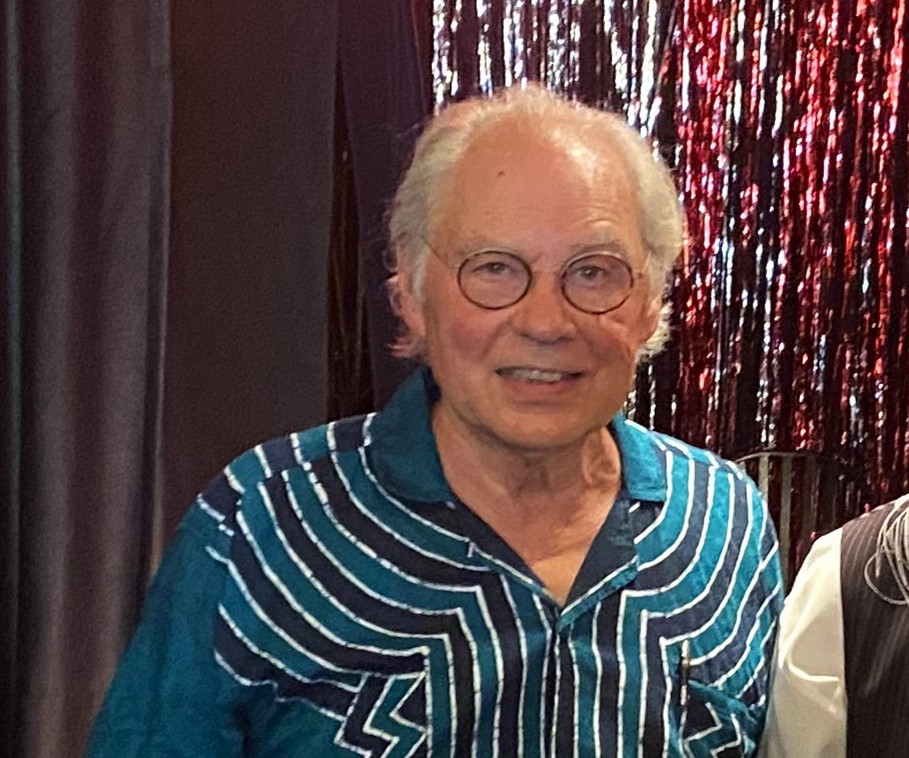
About the Author:
An educator and writer, Don grew up in Michigan and came to Canada in the 1960s. , where I more or less flunked out of a PhD program in Modern Chinese History. This turned out to be a blessing as it opened up a world of opportunity and experiences I never contemplated. From teaching in a small Newfoundland outport to training community workers in West Africa to teaching adults on a First Nations reserve in British Columbia to designing a climate change action course for Jamaican youth, I have worked with youth and adults from many cultural backgrounds and in a variety of locales.
Inevitably, these experiences have made their way into my writing. I have authored over 12 books, including two Canadian bestsellers: the YA novel Where the Rivers Meet (Pemmican) and the adult non-fiction Tomorrow Is School and I Am Sick to the Heart Thinking about It (Douglas and McIntyre). The first book in his Miss Flint series for children, The Meanest Teacher in the World (Thistledown) was translated into German by Carlsen (hardback) and Ravensburger. My articles and op-eds have appeared in many journals and most of Canada’s major dailies. My articles and op-eds have appeared in many journals and most of Canada’s major dailies
I was never a very good boxer, but I continue to train in the ring and walk in the woods whenever my hips don’t hurt too much. I currently live in St Catharines, Ontario, with Jan Henig Sawyer, my very tolerant wife of 54 years.
From a rural outport in Newfoundland and a First Nations community in British Columbia to West Africa and Jamaica, I have worked with youth and adults from many cultural backgrounds and locales. Inevitably, these experiences have made their way into my writing. I have authored over 12 books in several genres, including two Canadian bestsellers.
A writer and educator, Don Sawyer grew up in Michigan and moved to Canada in the 1960s.
He has worked with youth and adults from many cultural backgrounds and in a variety of locales, including teaching high school in a small Newfoundland outport, training community development workers in West Africa, teaching First Nations adults in British Columbia and designing a climate change action course for Jamaican youth.
Inevitably, these experiences made their way into his writing: Don has authored more than 12 books – including two Canadian bestsellers — in a variety of genres. His articles and op-eds have appeared in many journals and most of Canada’s major dailies
He currently lives in St Catharines, Ontario, with his wife of 54 years.
: the YA novel Where the Rivers Meet (Pemmican) and the adult non-fiction Tomorrow Is School and I Am Sick to the Heart Thinking about It (Douglas and McIntyre). The first book in his Miss Flint series for children, The Meanest Teacher in the World (Thistledown) was translated into German by Carlsen (hardback) and Ravensburger.
Before moving to Ontario, Don lived and worked in Salmon Arm BC for more than thirty years. There he taught adult education, served as the Chair of the Okanagan University College (OUC) Adult Basic Education Department, and acted as the Curriculum Director for the Native Adult Education Resource Centre. He also was a faculty associate with Simon Fraser University and coordinated the SFU North Okanagan Native Teacher Education Program.

 Scribble's Worth
Leave a comment