
Mirror Me is a conundrum. It is a charming picture book with colourful and diverse illustrations that will draw in young readers, with an unexpected turn in its narrative.
Mirrors are innocuous objects that are rarely thought about unless they are needed. Choosing a mirror as the vehicle of this narrative is not an original idea, however it was Hyde’s approach to mirrors that surprised me. Most picture books use mirrors to address facial features, such as eye or hair colour, whether the child looks like their parent, dimples, moles etc. For this book, Hyde used mirrors to introduce the topic of emotions. This was a creative and innovative way to approach the topic with young readers.
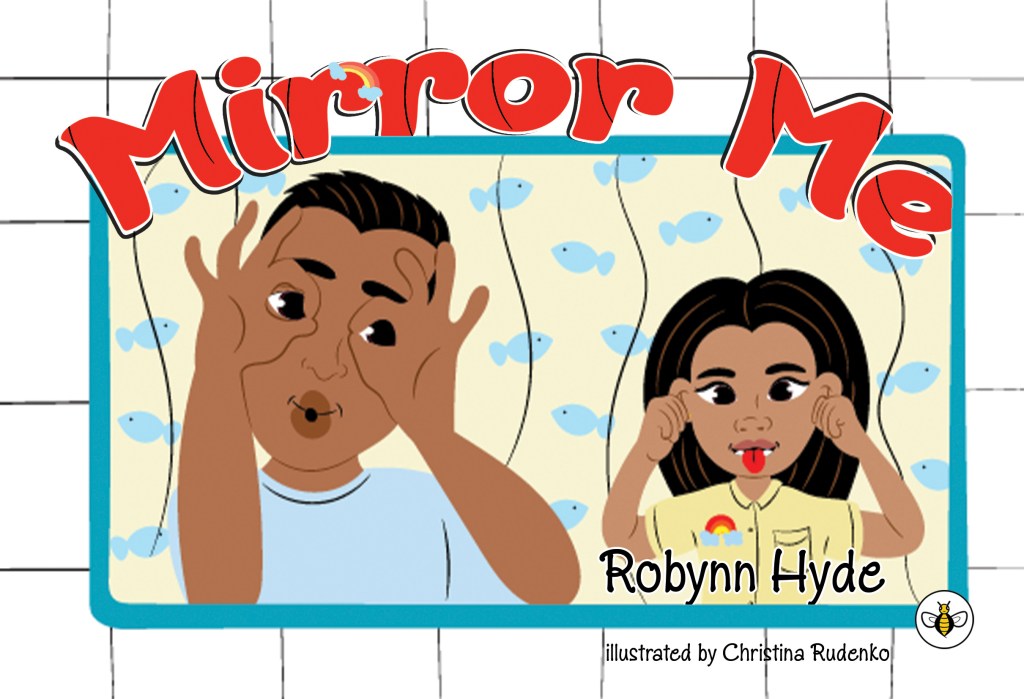
This approach intrigued and baffled me as the narrative didn’t develop how these feelings could be reflected or what they may even mean to the young reader. Hyde presented a situation and named a feeling that could be linked to it but didn’t venture any further, instead relying on the illustrations to solidify the point, which was disappointing. However, in just presenting a situation or thesis sentence, Hyde is invariably opening the field to further discussion as the adult reading the story with the young reader can use these ideations to expand on each emotion.
Instead of using the term ‘reflection’ Hyde presents the alternative, “Mirror Me” to identify feelings. This provided a didactic element to the story which then made it clear to me that this book’s purpose was simply to provoke conversation but not add to it.
Hyde uses simple sentence structures and basic activities that a young reader could relate to in order start a conversation on feelings. Whether by design or not, there is a specific audience for this book, and I do anticipate it finding a home in many pre-school classrooms where teachers can get young readers to vocalize and acknowledge their feelings.
The one drawback comes from the separation introduced between the ‘mirror me’ and the ‘me’. Though the target reader is young, this separation can invite confusion. Is “mirror me’ the reader or someone else? A case can be made that the potential reader is still too young to be able to recognize this distinction. That said, I have always felt that young readers are much more capable at grasping concepts and themes than we give them credit for. This age group is learning about identity and empathy, both crucial concepts to development and while I do not believe this is a deterrent to the enjoyment of this book, I do think that this possibility should be acknowledged.
Picture books are successful when the illustrator and the author are in sync and able to fully present the narrative. Christina Rudenko’s illustrations are a perfect example of this. She captured the emotions, and gave us a diverse cast representative of the society that we all live in. By including a range of cultures and ethnicities in the illustrations, it opens the door for a variety of readers to relate to and embrace this book. It has been proven that young readers relate to books and stories more when they can see themselves in the book being read and Rudenko was sure to include many young readers in her illustrations.
Mirror Me isn’t layered or nuanced. It isn’t going to tug at heartstrings or shatter perceptions. It won’t offer insight or address themes. It is going to do what Hyde set out for it to do which is invite conversation. Its illustrations will delight the young reader. The subject matter will be an aide for teachers and parents wanting to find a way to engage with their young reader. Mirror Me is the perfect kiddie pool to introduce feelings and emotions to the young reader.
Pros:
- Creative approach to the topic
- Illustrations demonstrated an authentic diverse society
- Specific Target Audience
- Perfect aide to introduce young readers to the topic
Cons:
- Specific Target Audience
- Topic could’ve been better developed, more layers injected
- Separation between ‘mirror me’ and ‘me’ can lead to confusion for the young reader
- Rainbow visual can be miscontrued
 Scribble's Worth
Leave a comment