
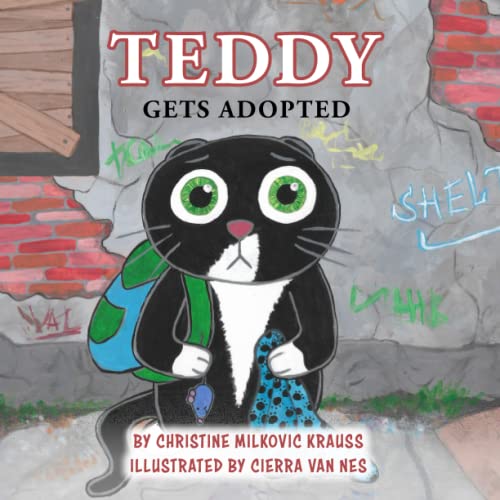
Charming! Endearing! Multilayered! I recognize that’s a lot of superlatives for a picture book, but “Teddy Gets Adopted” is so much more than what it appears to be. With colourful, delightfully drawn scenes as a backdrop, Krauss explores a profound and challenging subject with the nuanced experience of a maestro. Using Teddy’s journey, the multilayered topic of pet adoption and animal abandonment is presented through a palatable, relatable and winsome lens.
Full disclosure, this is not my first visit with Teddy. I was charmed by him and his family in the book “Teddy Loves Spaghetti” (review here). This time around, I have fallen in love. Teddy Gets Adopted, offered some insight into Teddy’s past and his journey to his ‘forever’ home. For those not familiar with Teddy, this book is an enchanting introduction. For others, this is a welcome companion to the series (reviews here). Knowing Teddy’s history makes him even more endearing!
Contemporary young readers are more socially aware and thereby able to engage with profound subject matter. Invariably, many may have already encountered the term ‘adoption’ be it with a classmate or friend or pet. The topic of pet adoption and abandonment can be heart wrenching, but Krauss was able to approach it with simple and light vocabulary that brought some levity to what could be construed as a heavy and emotional subject. This book is a kind teaching tool that will provoke engagement as the young reader sympathizes with Teddy’s predicament.
Krauss demonstrated the refined skill of a natural storyteller as she sensitively and openly explored this topic. Her pedagogical background was on full display as she wove a difficult topic through the perspective of Teddy, a relatable and child-friendly totem, thus creating a space for the young reader to approach and discuss this social and emotional issue. In so doing, Krauss displayed a keen understanding of the young reader while providing the parent, teacher, or other adult a ‘key’ to unlock the door to discussing this tender topic, which can be expanded to include human adoption.
Though pet adoption is the primary theme of the plot, throughout the book, the reader sees Teddy experience a series of emotions on his journey. These emotions connect the main plot to sub-themes of sadness, fear, longing, loneliness and eventually, happiness and belonging. These subsequent themes are all concepts the young reader can empathize with. Through Teddy’s journey, the young reader is exposed to language and situations that will enable them to digest and discuss these themes at their level, once again showcasing Krauss’ storytelling and didactic acumen.
Cierra Van Nes’ illustrations buoyed Krauss’ tender storytelling. Teddy’s essence and emotions emanated from the colourful depictions. I was especially chuffed to see the incorporation of pasta as this reinforced Teddy’s character (seen in previous books) and cemented the series’ continuity. Van Nes and Krauss once again proved to be felicitous collaborators as they brought Teddy to life on these pages.
Krauss’ inclusion of the map and names of Animal Shelters and Safe Places enhanced the book’s primary theme. It also provided practical information that underlined Krauss’ secondary goal, which appealed for social involvement of any kind. This incidental aspiration will inspire young readers, and by extension their adult counterparts, to become even more socially active, aware and responsible.
Teddy Gets Adopted is so much more than a picture book about a kitten getting lost and then finding his forever home. Together, Van Nes and Krauss opened up a world to young readers that encompassed a spectrum of emotions while exploring a tender topic. Teddy is likeable and relatable and his journey will easily charm every reader, even non-cat lovers. This book will fit into any pre-school or kindergarten class or household and easily become a favourite, but be warned, it will undoubtedly provoke a litany of requests for a new kitten from young readers! Everyone will want their own Teddy to bring home…
Pros:
Informative and multilayered
Relatable teaching point as basis of plot
Variety of themes introduced through the main plotline
Injection of Map and names of Animal Protective Shelters
Charming Illustrations that reinforce continuity of Teddy’s character
Cons:
- Multiple requests for kittens from young readers
 Scribble's Worth
Leave a comment