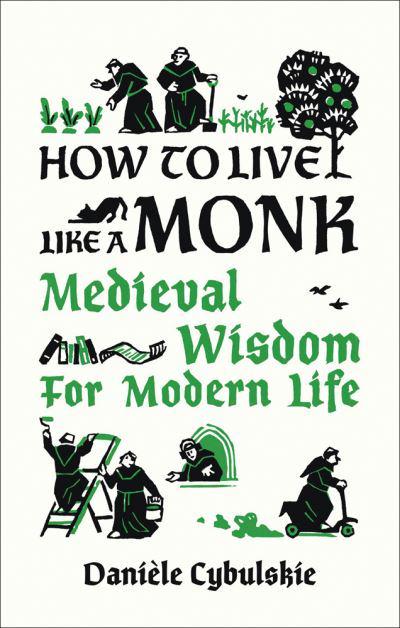
Full disclosure: I was skeptical of the contents of this book based on the title. Even though I am a practicing Catholic (Christian), I questioned why anyone would be interested in a how-to on monastic living—and medieval monastic living at that. Personally, I can see no real appeal to a return to what I think of as unenlightened scarcity. Admittedly, the introductory chapter confirmed my initial reaction as the author fully defined the term ‘monk’ and described their rules for living, Ad Regulam. At the end of the chapter, I was again questioning why anyone in this millennia would willingly choose to live such an extreme lifestyle, even with the author’s clarification of the definition being used to classify the term ‘monk.’ However, my skepticism was steadily replaced with a recognition of the lifestyle’s appeal.
Danièle Cybulskie does a remarkable job in pulling out the tenets of the medieval monastic lifestyle, linking them to contemporary challenges, and offering opportunities for a beneficial symbiosis between the past and future. How to Live Like a Monk is unlike the traditional how-to, self-help guidebook. Its thesis is persuasive, its proposals for integration feasible, and its appeal undeniable.
While this book was refreshing and novel in its approach, it is, at its essence, a self-help guide. In the genre of self-help, there are not many new techniques or methods. I do believe all of mankind is aware that the true key to living an improved lifestyle is balance. As such, the books in this genre all promote this foundational principle, albeit using varying methods and perspectives. This perspective, the ‘elevator pitch’ or the ‘unique selling point,’ refreshes the genre. By reaching backward, Cybulskie proposes an ultra-modern perspective to well-tried and already touted techniques as current society celebrates revivals.
One need not look too far to find this inclination as everything ‘old’ is now a ‘new’ opportunity, as seen in fashion, media, cuisine, ideology, and even legislature. By offering this option of embracing an archaic and extreme lifestyle, Cybulskie inevitably appeals to the readers’ curiosity and contemporary society’s appetite for a renaissance that innately carries the potential to become the next trend. In fact, I can already hear a Kardashian’s SoCal nasally languid accent droning about their adoption of the monastic lifestyle that helped them achieve ‘the ultimate way of living’—cue their millions of followers jumping onto the bandwagon while completely missing the point. While I do recognize that creating a ‘trendy movement’ may not be the author’s intention for writing this book, I do appreciate that its potential to do so is apparent.
Cybulskie presented insightful links between this antiquated lifestyle and current challenges plaguing contemporary society, such as mental health, eating habits, ego and vanity, social behaviours, and isolation. Ironically though not surprisingly, many of these challenges also faced medieval monks. The advent of the pandemic created a tilling of the soil, so to speak, where societal issues have become more exposed as many seek to develop more balance and stability that felt elusive before the pandemic. Cybulskie deftly identified key areas where the monastic lifestyle can seamlessly be integrated into modern life. Each of these aspects is explored per chapter by first presenting the history and logic behind each of the methods being proposed as they extend organically from their monastic roots. The chapter titles give a cheeky herald to what could be expected within.
The “Tend Your Plants and Soul” chapter relates to the environment, natural and internal, as it affects your way of life and the importance of nature in preserving your equilibrium. As an aside, there is a case made for herbalism, but not in a dogmatic tone. Throughout the book, Cybulskie recognizes the advantages of technology and modern medicine towards enabling that lifestyle balance. Another tenet explored in the second chapter is minimalism and prioritizing certain aspects of life while acknowledging the fatigue that befalls many when overindulgence in any form (social media, food, consumerism) takes precedence.
In addressing Mental Health and Psychology, the chapter ‘Look Inward” delves into meditation, education, focus and again finding that balance. The roles of Creativity, Innovation, and Technology are explored in the Chapter entitled “Look Outward.” The book’s thesis is fully realized in the final chapter, and by “Ad Meliora,” the author has given a fully developed roadmap to incorporating and adapting these monastic tenets psychologically, anthropologically, and culturally, with justifiable rationale.
Filtered throughout the text were colourful illustrations relating to the monastic lifestyle. They were vivid and instrumental in presenting a visual of much of the historical conditions being explored relating to artefacts, blueprints of monasteries, and the monastic lifestyle. The inclusion of these illustrations also elevated this book from the typical self-help tome by infusing a more educational/historical quality to it. They also assisted with breaking up the narrative and injecting pauses while the author made links and insights. That said, many of the illustrations were just pretty pictures, and I would argue that the book could just have easily accomplished its primary goal without them.
This book is innovative in its simplistic approach as it embraces the old adage: ‘knowledge of history is essential to crafting a better life.’ How to Live Like a Monk is surprisingly feasible to implement, and unbeknownst to any reader, many of the techniques may have already been incorporated into one’s life. This book is especially relevant, as this is the time of year when everyone seeks a better ‘New Year.’ Surprising! Refreshing! Feasible! All the hallmarks of an accomplished thesis and bestseller!
Cons:
- Reader can be deterred by the title
- Open to reader bias associated with Christianity and the corresponding hegemony
- The proposed methods are already known
Pros:
- Fresh perspective to well-tested methods
- Links made were insightful
- Persuasive narrative with limited to little bias
- Inclusion of glossary, index, notes, and recommended reading
- Interesting facts regarding timekeeping and the correlation made between the church and the time-obsession of modern society, as well as the history behind ‘red-letter days’
 Scribble's Worth
Leave a comment